
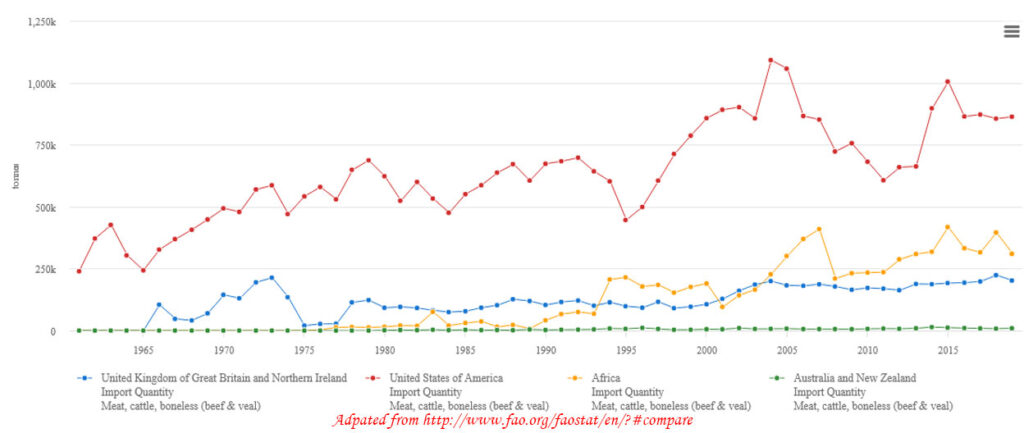
Beef importation in United states of America, United Kingdom, Australia and Africa has been on upward trend since 1965 and projected to keep increasing especially in Africa due to the developing economy and growing population1. This means the demand for beef across the continents is consistently increasing. Leveraging on this demand can be a good idea to embark on beef feedlot business on any part of the continent. The following are ten features to consider in a feasibility study for your feedlot business
- Business plan
Business plans are overrated on one hand and underrated on the other hand depending why you decide to develop one. Majority of startups only decide to write a business plan when they intend to acquire loan from the bank. This reason for developing a business plan though important may not be focused on the business itself rather just to satisfy the bank requirement in which case its always unrealistic. More important reasons you will need a business plan are;
- Business plan acts a blueprint for your business and therefore it’s a manual and a guide to start your beef feedlot business as well as assessing its profitability
- It may act as a business proposal to be discussed with investors and evaluate its viability
- It will help to manage your business more effectively
- Helps in analyzing the beef feedlotting on the paper and identity the weakness and opportunities
- Helps lenders, venture capitalist and other investors with a clear understanding of the business incase you may need external source of capital or credit to finance the business
- It will help to analyses the marketing strategies and standard operating procedures for your beef feedlot business
- Helps to understand the financial requirements, performance projections and cash flow details. This will help in understanding the financial expectations to execute and sustain the business till profitable
Though business plan is an essential feature of your beef feedlot business, the business structure and model dictates what kind and magnitude of business plan you may need. Many people execute their business with a little business plan at the back of their minds or some few notes scribbled on a notepad. Majority of these businesses succeed because they tend to be realistic in the plan’s dues to simplicity. However, a proper, executable and realistic business plan is important for your beef feedlot business
2. Land
Beef feedlot site selection is very important. Most countries have requirements to be met before setting up the feedlot business including effluent and manure disposal. The market as well is moving towards grass feed beef compared to grain feed beef for the purposes of environmental stability and use of resources in a more sustainable manner. Other factors to consider includes accessibility through all-weather roads for transportation of the live or beef to the market. The site must provide quality soil and water for fodder production. The size of the land should be enough to keep the current density of the feedlots till the last months of fattening. The suggested density is about 1.5 animals per hectare2.
3. Breed and Source of initial breeding stock or in calf heifers
Breeding stock is a very key item of the beef feedlot. The selection of the breeding stock may be influenced by factors at your disposal and your business modal. Some of the factors that may influence your breed selection include the breed availability, the finances available as some breed are quite costly for a startup, the growth rate, fertility rates, feed conversion rates and ability to resist diseases. Some of the beef breeds include Angus, Hereford, Simmental and limousin among other. Indigenous breeds are likely to be more disease resistant compared to the exotic breeds. Breeding your cows can be done by artificial insemination. This is best method for quick improvement of your herd. Or you may use a bull which may be risky in terms of likelihood of transmitting venereal diseases.
Based on the factors addressed above you should able to adapt a business modal and structure to kick start your business and upgrade and your business grows
4. Human resources
Staffing your beef feedlot with the correct team is very important for your success. The staff will include the herders, front office team and probably the overall manger. The staff acquired at the beef feedlotting should at least be able to understand basic animal health issues, feeding/nutrition and production. The staffing will be determined by the scale of your beef feedlot business. Mostly, as a startup this could be a purely family supported business. In this case it’s very important to educate the family members about animal nutrition, health issues and productions issues. A support from the veterinarian will be required to advice on disease control and biosecurity.
Each staff whether employee or family member should understand their job description very clearly and what is expected of them. These may include, feeding records and feeding time, record keeping, breeding and general health supervision as well as monitoring of growth rates and target market weights.
5. Farm structures and equipment
Farm structures and equipment make it easier to manage your beef animals. Fencing in beef feedlot will be very useful especially in grass fed beef feedlots. This will be done to create paddocks to preserve your hay and other fodder in the farm. Housing for feedlots is necessary especially during last months of fattening and in harsh weather conditions like during winter. Housing could be open lot with shed or windbreakers. They could be earth or concrete floored, deep bedded confinement or slatted floors. Restraining structures like crashes for examination and breeding especially during artificial insemination are important. Equipment may include-feed and water troughs, manure spreader among others
6. Feeds and supplements
Feeds and supplements are the variable costs or inputs in the beef feedlot. This means that the scale of operation determines how much of feed and supplement to be used at any feeding session. The cost of feeding at the market weight will be determined by the kind of stock acquired for feedlotting. If the calf-feeders are too young and malnutritioned it may take longer than expected to get them to market weight hence feeding more. Feeder cattle almost to the market weight may cost abit higher but may be more profitable depending on the market. Beef market tend to be cyclical and prices may go low or high depending on the cycle trend and the seasons
Feedlots will require proteins (soya meal, fishmeal, Lucerne etc.), carbohydrates (maize grain, wheat bran, Rice bran etc.) and minerals/vitamins to maintain a healthy growth and achieve market weight at the right time period
7. Disease management and biosecurity
Good management practices are essential in control and prevention of diseases in the beef feedlot. Depending on the model adopted whether its open system whereby new feedlots are introduced from outside the farm or closed system where feedlots are breed within the farm will dictate the level of biosecurity required. Farm structures like fencing will be very useful in containing your beef animals and avoid interaction with free ranging animals which might spread infectious diseases to the farm. Foot bath with disinfectants along all the entry points will help in controlling any entry of pathogens to the farm
Disease control through vaccinations must be done in consultation with your local veterinarian to advise the most prevalent diseases to vaccinate against. Good management standard operating procedure checklist for sanitation, equipment’s, farm implements, vaccination and deworming plans must be development and implemented
8. Quality water
Beef feedlots will require clean and safe water ad libtum meaning available all the time. The water at your farm should be analyzed for basic components such as presence of toxic components, the concentration of macro-and micro minerals, microbial contamination, salinity and the pH
Excessive minerals can create an opportunity for mineral antagonism. Some minerals will bind to trace elements making them deficient to the animals.
The pH which measures the amount of acidity or alkalinity of water should be around 6-8.5 for beef feedlot. The salinity measuring the total solids dissolved in water should be around 7000-10000ppm
9. Cashflows
A business can be fully financed to lick off but if the cash flows are not right the business may close soon. Basically, Cash flow is the amount of money flowing in and out of the business. Cash flow budgets can be estimated by knowing your full farm plan. That is; estimate the number of feedlots per session and how much feed they require, secondly estimate the sales from the finished feedlots, thirdly estimate other cash incomes probably from sale of manure. Realistic cash flow projections should be done so that you understand the cash requirements in future and at what point you may need credits
10. Value addition
Beef feedlot value addition can fetch premium prices hence better profits. Grass feed beef feedlots fetch better prices compared to grain feed feedlots. Provision of dressed carcass, processing of meat to biltong and meat canning are some of value addition processes that may be considered in a feedlot business
11. Market trends and target market
The global beef market is expected to grow up to USD 383.5. This will be a 3.1% growth compounded annual growth rate.3 The growing awareness of beef as a major source of protein and growing population especially in Africa will drive the demand.
Local and export markets can be explored. The local market will constitute the hotels, schools, food processing companies, restaurants and government. The export market will depend on the sanitary and phytosanitary requirements of each country as per the world trade organization.
References
1. FAO. FAOSTAT. Published 2019. Accessed August 8, 2021. http://www.fao.org/faostat/en/?#compare
2. Broom DM. Land and Water Usage in Beef Production Systems. Animals (Basel). 2019;9(6):286. doi:10.3390/ani9060286
3. ltd R and M. Beef Market Size, Share & Trends Analysis Report By Cut (Brisket, Shank, Loin), By Slaughter Method (Kosher, Halal), By Region (North America, Europe, APAC, MEA, CSA), And Segment Forecasts, 2019 – 2025. Accessed August 14, 2021. https://www.researchandmarkets.com/reports/4751767/beef-market-size-share-and-trends-analysis